How PVC ID Cards Are Made: Step-by-Step Printing Process
Commercial identity cards are fundamental components of modern corporate security, facility access, and brand representation. While a finished badge appears to be a simple piece of plastic, the engineering and chemical processes required to produce an enterprise-grade identification credential are highly sophisticated.
Understanding the technical mechanics behind how pvc id cards are made allows operations managers, security directors, and procurement officers to make informed decisions regarding material durability, print fidelity, and fraud prevention.
Below is a detailed, step-by-step breakdown of the industrial manufacturing and printing workflow used to transform raw polymers into high-definition, secure identification tools.
Step 1: Substrate Composition and Material Selection
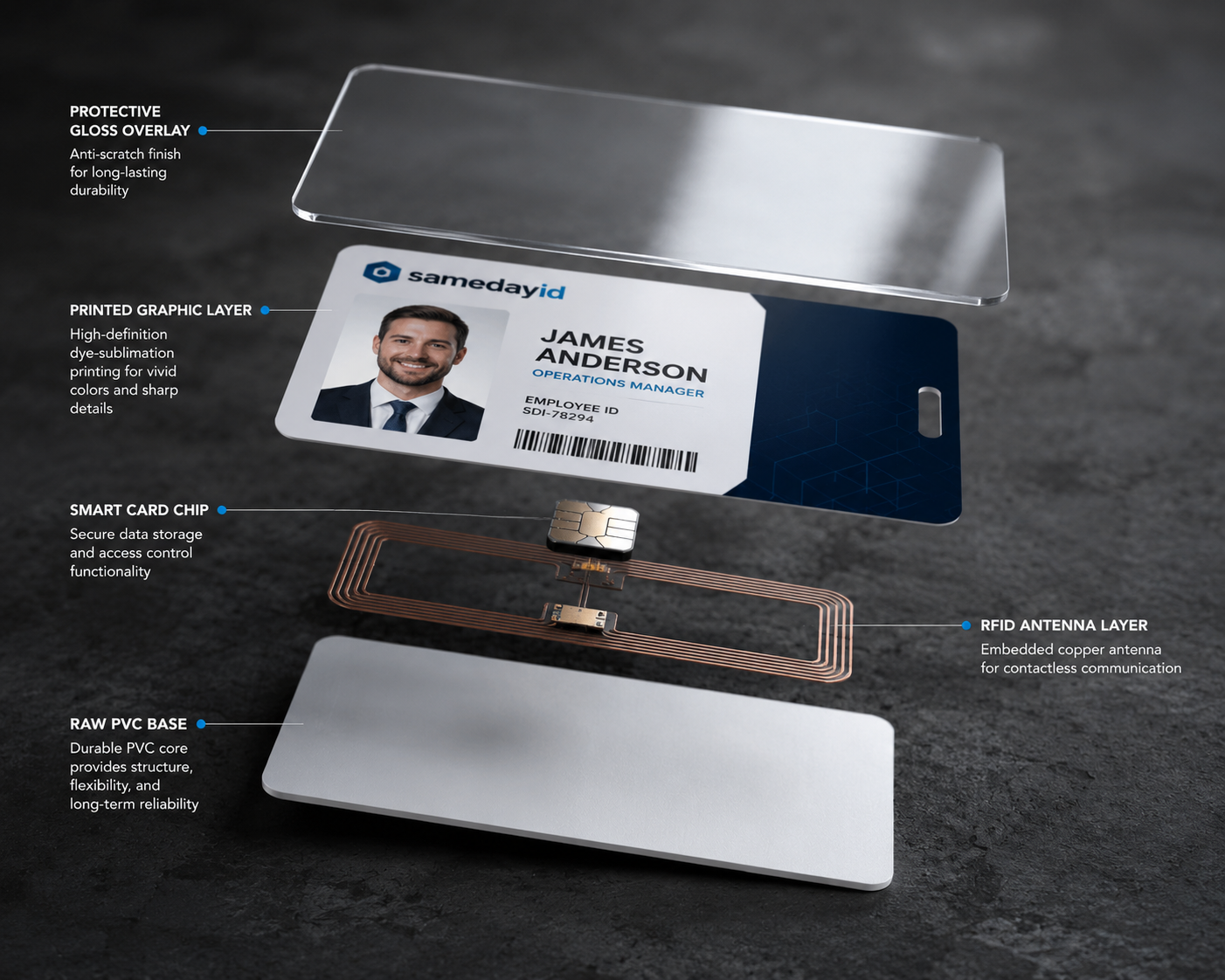
The lifecycle of an identification badge begins with the raw substrate material. Industrial-grade credentials rely on Polyvinyl Chloride (PVC) or a composite blend of PVC and Polyethylene Terephthalate (PET).
+-----------------------------------------------------------------------+
|                       PVC SUBSTRATE ARCHITECTURE                      |
+-----------------------------------------------------------------------+
| Core Material: High-density polyvinyl chloride polymers               |
| Standard Dimensions: CR-80 Specification (3.375" × 2.125")            |
| Standard Caliper/Thickness: 30 mil (0.030 inches / 0.76 mm)           |
| Surface Properties: Chemically polished, static-free, de-ionized     |
+-----------------------------------------------------------------------+
| Structural properties provide optimal flexural strength and impact    |
| resistance required for everyday commercial use.                      |
+-----------------------------------------------------------------------+
For specialized smart environments, the core substrate is split into multi-layer laminates. This allows production lines to embed ultra-thin Radio Frequency Identification (RFID) microchips, micro-antennae, or copper proximity wiring directly between the PVC layers before final compression, ensuring a perfectly flat exterior surface ready for imaging.
Step 2: Digital Asset Validation and Pre-Press Calibration
Before physical production commences, digital design templates undergo rigid pre-press processing. High-volume manufacturing workflows require that all graphic elements align perfectly with industrial print parameters:
Resolution Scaling: All image assets, corporate logos, and text strings must be rendered at a minimum threshold of 300 DPI (Dots Per Inch) to prevent pixelation or edge blurring.
Color Space Conversion: Graphic files must be calibrated from digital display spectrums (RGB) to physical pigment frameworks (CMYK or specialized spot color matrices) to ensure accurate brand reproduction.
Bleed Configuration: Designs must extend slightly beyond the theoretical cutting boundaries of the CR-80 perimeter to eliminate the risk of unprinted white borders during mechanical shifts.
Step 3: Thermal Dye-Sublimation or High-Definition Retransfer Imaging
Once calibrated, the digital data is transmitted to high-capacity commercial print systems. Industrial manufacturing primarily relies on two professional methods to apply imagery to the PVC core:
Method A: Direct-to-Card (DTC) Dye-Sublimation
This process utilizes a specialized thermal print head that makes direct contact with the PVC card surface. The print head applies precise bursts of heat to a multi-panel ink ribbon containing solid cyan, magenta, yellow, and black (CMYK) pigments. The heat vaporizes the ink into a gas, which instantly permeates the open pores of the plastic surface. As the temperature drops, the pores close, locking the coloration directly inside the polymer structure.
Method B: High-Definition Retransfer Printing
For advanced security cards with embedded electronics or edge-to-edge designs, retransfer printing is preferred. Instead of printing directly onto the plastic, the thermal print head transfers a reverse image onto a clear, thin flexible film. An automated heated roller then bonds this printed film completely to the card surface under high pressure. This technique prevents image distortion caused by internal chips or uneven surfaces.
Step 4: Security Encoding and Functional Integration
Following the imaging stage, functional components are activated and encoded based on specific organizational access protocols:
Magnetic Stripe Polarity: High-coercivity (HiCo) or low-coercivity (LoCo) magnetic tracks are passed under induction heads to alter the magnetic domains, encoding internal user identification strings.
Smart Chip Initialization: Contact or contactless microchips (such as MIFARE or RFID architectures) are programmed using secure encryption keys to link the card to specific automated physical access control systems.
Variable Data Placement: Laser engraving or high-impact thermal heads append real-time alphanumeric data—such as unique employee serial numbers, precise issue timestamps, and variable barcodes—onto individual badges.
Step 5: Protective Overlays and Automated Quality Assurance
The final phase of production focuses on protecting the card from surface damage, environmental wear, and counterfeiting. A specialized clear topcoat—such as an anti-scratch overlay or a heavy-duty ultraviolet (UV) protective laminate—is applied across the entire face of the badge under intense heat and pressure. This sacrificial layer protects the underlying print matrix from fading under UV exposure or scratching due to daily handling.
The Industrial Inspection Checklist
Before batch packaging, cards pass through an automated optoelectronic monitoring station to confirm compliance with international manufacturing benchmarks:
[ ] Dimensional Compliance: Verification that edges strictly align with the standard CR-80 geometry within a tolerance of ±0.01 mm.
[ ] Color Contrast Inspection: Optical scanners verify color consistency against pre-approved master brand profiles to detect pigment drift.
[ ] Data Read Back Validation: Magnetic stripes, QR codes, and internal proximity chips are electronically scanned to verify data transmission integrity.
[ ] Structural Lamination Audit: Thermographic sensors inspect the surface for micro-fissures, air bubbles, or edge peeling.
Approved credentials are systematically packed in anti-static, dust-filtered containers and cleared for logistics dispatch.
Turnaround Solutions for Corporate Badge Deployments
Managing an on-site credential migration, replacing lost employee tokens, or executing a large-scale structural onboarding requires an efficient production workflow. Handling these needs internally often introduces equipment downtime, material waste, and unexpected maintenance costs.
For organizations requiring urgent support, sameday.com offers specialized, industrial-capacity production lines engineered to handle premium bulk pvc card printing under compressed timelines. By combining high-definition thermal imaging with automated quality assurance systems, our platform ensures every credential meets the highest standards of clarity, security, and structural durability.
Frequently Asked Questions (FAQs)
What is the primary difference between PVC and composite PET/PVC cards?
Standard PVC cards consist entirely of polyvinyl chloride polymers, providing excellent print clarity and cost-effectiveness for standard use cases. Composite cards integrate a polyester core (typically 40% PET and 60% PVC), which enhances structural flexibility, temperature resistance, and durability. This makes composite cards ideal for environments where badges are frequently swiped or subjected to extreme conditions.
Can PVC ID cards be printed using standard office inkjet technology?
No. Standard office inkjet printers rely on liquid, water-based inks that cannot adhere to non-porous plastic surfaces, resulting in smearing and instant degradation. Commercial ID card production requires specialized thermal transfer or dye-sublimation hardware designed to fuse dry pigments directly into the underlying plastic structure.
What causes an identification card to fade or peel over time?
Premature degradation is typically caused by friction against card slots, chemical contact, or prolonged exposure to ultraviolet (UV) radiation from sunlight, which breaks down standard ink molecules. This risk is minimized during professional production by applying an advanced anti-UV clear overlay or heavy-duty laminate over the printed layers.
How are holographic security elements integrated into PVC badges?
Holographic features can be applied via two primary production pathways. They can either be pre-embossed directly onto the raw plastic substrate prior to printing, or integrated into a clear laminate foil that is thermally fused over the card surface during the final manufacturing step. This creates an overt security feature that is exceptionally difficult for unauthorized parties to replicate.