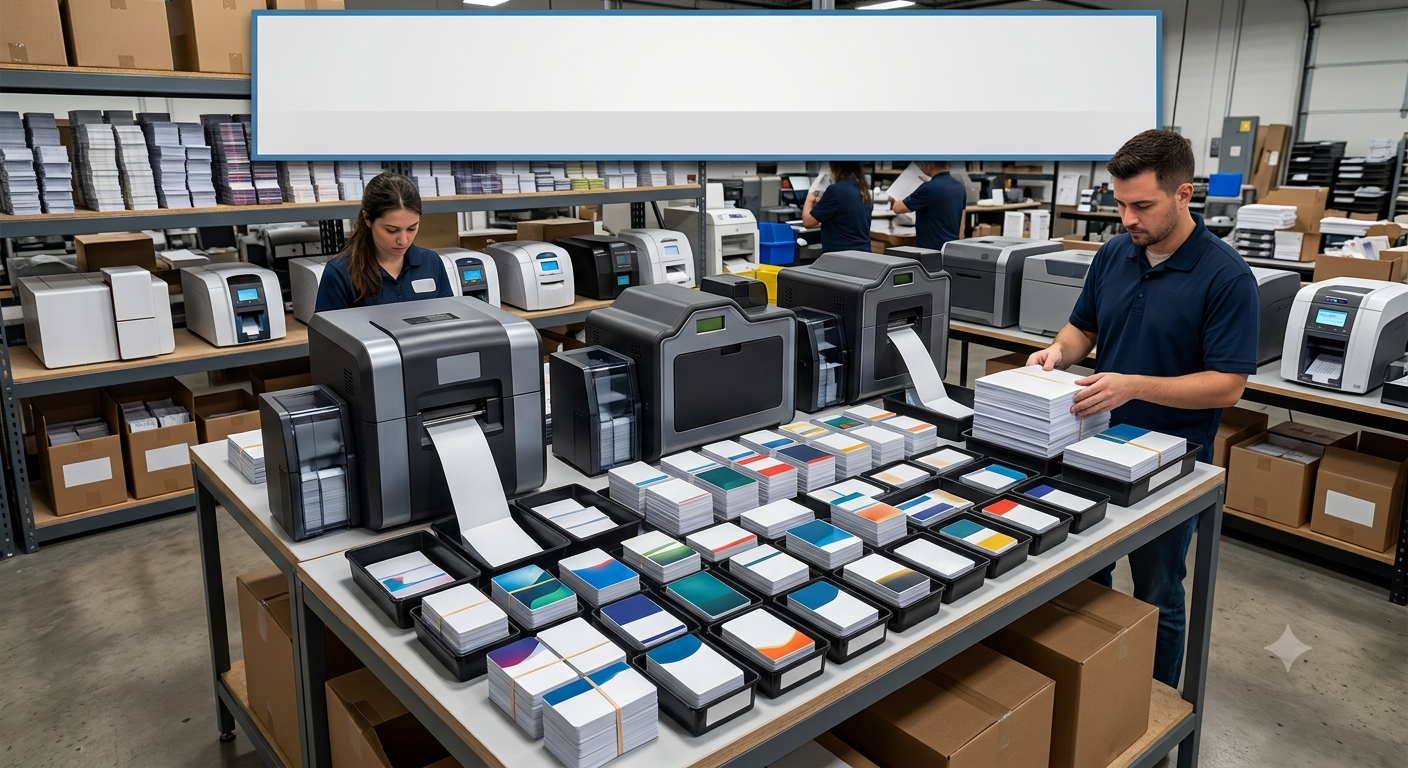
Standard PVC cards suit most ID programs: they print well, feel sturdy and cost less. Composite cards, which blend PVC with polyester, handle heat and bending better, so they make sense for cards that see heavy daily use or go through laminators and retransfer printers.
Need cards soon? Start your design on the order page. Orders placed before the 1 PM ET cutoff go into same-day production. Shipping time depends on the method you choose at checkout.
We review every order before it prints.
Last updated: November 5, 2026
What PVC cards are
PVC (polyvinyl chloride) is the standard material for ID cards. Its smooth surface takes dye-sublimation printing well, so photos and logos come out sharp. CR80 PVC cards at 30 mil thickness are what most people picture when they think of a badge. They are flexible enough to carry in a wallet and stiff enough to hang on a lanyard.
What composite cards are
Composite cards mix PVC with PET (polyester), often around 60/40. The polyester core makes the card more resistant to heat and less likely to warp or crack. That matters in printers that use high heat, such as retransfer printers and laminators, and in environments like vehicles in summer or industrial sites.
Durability compared
For an office badge that lives on a lanyard, standard PVC holds up well with reasonable care. Cards that get bent in back pockets, swiped many times a day, left on dashboards or clipped to gear in hot or cold conditions benefit from composite. Composite cards keep their flat shape longer, which also helps any reader that needs the card to sit flat.
Print quality
Both materials print well with dye-sublimation. PVC has a slight edge in color vibrancy on direct-to-card printers because of its surface. Composite cards are often the better partner for retransfer printing and lamination because they tolerate the extra heat. The design itself, including photo quality and contrast, matters more than the material for how a card looks.
Cost factors
Composite cards usually cost more per card than standard PVC. For large programs where cards are replaced often, PVC keeps costs down. For long-life cards or harsh environments, composite can pay for itself by lasting longer. Ask for a quote at your real quantity before deciding.
Environmental notes
Some buyers prefer composite cards because the polyester share means less PVC per card, and some suppliers offer cards with recycled content. If sustainability matters to your organization, ask what card stock is available.
Questions to ask before you decide
Ask where the card will spend its day: on a lanyard indoors, in a back pocket, on a vehicle visor or clipped to work gear. Ask how often it will be swiped, tapped or handed over. Ask how long you expect it to last before replacement, one school year, one event or several years. Ask whether the card will be laminated or printed edge to edge. And ask how many cards you replace each year now. The answers usually point clearly toward one material. Many organizations end up using both: PVC for the bulk of staff and visitors, and composite for the small group whose cards take the most wear.
Side-by-side comparison
- Material. PVC: polyvinyl chloride. Composite: PVC blended with polyester (PET), often around 60/40.
- Heat tolerance. PVC: can warp with high heat. Composite: holds shape better.
- Flexibility. PVC: flexible, can crack if bent repeatedly. Composite: more resistant to bending damage.
- Print look. PVC: very vibrant on direct-to-card printers. Composite: prints well and handles lamination and retransfer heat.
- Cost. PVC: lower per card. Composite: higher per card.
- Best for. PVC: office staff, events, students. Composite: field crews, vehicles, frequent swiping, laminated cards.
Common mistakes when choosing card material
Choosing composite for a one-day event spends money on durability nobody needs. Choosing standard PVC for cards that live on a truck visor leads to warped cards within a season. Another mistake is laminating standard PVC cards in a hot laminator, which can curl them. Finally, some teams pick a material without asking how the card will be carried. Start with the real use, and the material choice usually follows.
Matching material to common programs
- Office employees on lanyards: standard PVC.
- Conference and trade show badges: standard PVC.
- Students carrying cards in backpacks: standard PVC with a holder, or composite for heavy use.
- Warehouse and field staff: composite.
- Drivers who keep cards on a visor: composite.
- Cards that are laminated after printing: composite.
- Visitor badges reused daily: composite, or PVC in a rigid holder.
If a program mixes these groups, you can order each group on the material that fits it and still use one shared design so the cards look like a set.
How to choose
Choose PVC for office staff, events, students and most everyday badges. Choose composite for field crews, warehouses, vehicles, frequent swiping or anything going through a laminator. If you are unsure, tell us how the card will be used when you order and we can talk through the options.
Related reading
- Choose your card and start a design
- how PVC ID cards are made
- PVC vs. paper ID cards
- making PVC cards last
Frequently asked questions
Is composite better than PVC for ID cards?
Composite is more heat and bend resistant. PVC is cheaper and fine for most everyday badges.
What is a composite ID card made of?
A blend of PVC and polyester (PET), often around 60/40.
Do composite cards print as well as PVC?
Yes, both print well. Composite handles the heat of retransfer printing and lamination better.
Which card lasts longer?
Composite usually holds its shape longer under heavy use or heat.
Can composite cards go on a lanyard?
Yes. They can be slot punched or placed in a holder like PVC cards.
Do composite cards look different from PVC?
Most people cannot tell them apart by sight. The difference shows over time in how well they keep their shape.
Ready to get started?
When your design and names are ready, start your order. Orders placed before the 1 PM ET cutoff go into same-day production, and shipping time depends on the method you choose at checkout. Start your order now
Also see our sister brand WorkIDCard for multi-site employee badge programs.
We review every order before it prints.